

Tomohiro Tachi
Tomohiro Tachi
Designing Stiff and Flexible Origami
Two of major approaches for applied origami in mechanical engineering are (a) to obtain stiff lightweight structures including folded plate shell structures, and sandwich panels with origami cores, and (b) to obtain flexible deployable mechanisms. Since the stiffness of type (a) structure is obtained when the boundary is closed to form cylinders or when each part is assembled and adhered to other sheets, the straightforward expectation is that the stiffness and the flexibility are mutually exclusive properties of origami.
However, recent studies on rigid origami, i. e., plate-and-hinge mechanisms, allow us to design deployable and yet stiff structures through the use of geometrically compatible rigid thick materials or foldable cylindrical and composite structures.
In this talk, the speaker introduces design methods for such stiff and flexible origami systems by producing statically indeterminate unstable structures.
About Tomohiro Tachi
Tomohiro Tachi is an Assistant Professor of Graphics and Computer Sciences, at the University of Tokyo. He is a world renowned origami artist and researcher. His expertise is in architectural and computational origami, physics-based design, digital fabrication, kinetic structures and form finding methods for origami. Prof Tachi has developed a number of origami computational tools and has developed fundamental theory in the area of rigid folding.
See website: http://www.tsg.ne.jp/TT/index.html
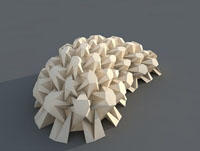
Freeform Origami Tessellation Designed by Generalization of Resch's Patterns