
NLS++: A unified library of nonlinear solution schemes
Nonlinear problems are prevalent in structural and continuum mechanics, and there is high demand for computation tools to solve these problems. The governing finite element equations and constraint equation for various solution schemes are combined into a single matrix equation. This theoretical model leads naturally to an effective object-oriented implementation.
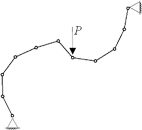
2D ABAQUS UEL for the PPR potential-based cohesive model
The PPR potential-based cohesive zone model is implemented in a commercial software, i.e. ABAQUS, as a user-defined element (UEL) subroutine. The source code of the UEL subroutine is provided for a two-dimensional linear cohesive element for educational purposes.
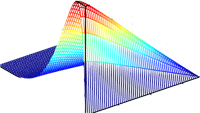
3D ABAQUS UELs for the PPR potential-based cohesive model
The PPR potential-based cohesive zone model is implemented in a commercial software, i.e. ABAQUS, as a user-defined element (UEL) subroutine. The source code of the UEL subroutine is provided for a small library of three-dimensional cohesive elements, i.e. linear brick elements, linear tetrahedral elements, and quadratic tetrahedral elements, for educational purposes.
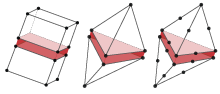
Integration of singular enrichment functions in the generalized/extended finite element method
A mapping method is developed to integrate weak singularities, which result from enrichment functions in the generalized/extended finite element method. The integration scheme is applicable to 2D and 3D problems including arbitrarily shaped triangles and tetrahedra. Implementation of the proposed scheme in existing codes is straightforward. Numerical examples for 2D and 3D problems demonstrate the accuracy and convergence properties of the technique.
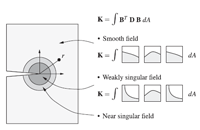
BEAN: Boundary Element ANalysis
Symmetric Galerkin Boundary Element Method presents an introduction as well as recent developments of this accurate, powerful, and versatile method. The formulation possesses the attractive feature of producing a symmetric coefficient matrix. In addition, the Galerkin approximation allows standard continuous elements to be used for evaluation of hypersingular integrals.
Development of user subroutines in commercial software (UMAT and UEL in ABAQUS)
ABAQUS allows user to add user subroutines to achieve specific functionalities. This material subroutine UMAT is implements graded elements with variable conductivity in ABAQUS. It can incorporate any functional variation of heat conductivity and specific heat.
Reference: A. Sutradhar and G. H. Paulino. "A simple boundary element method for potential problems in nonhomogeneous media". International Journal for Numerical Methods in Engineering Vol. 60, pp. 2203-2230, 2004.